Six-Syllable Mantra Ring Meaning: Om Mani Padme Hum & More
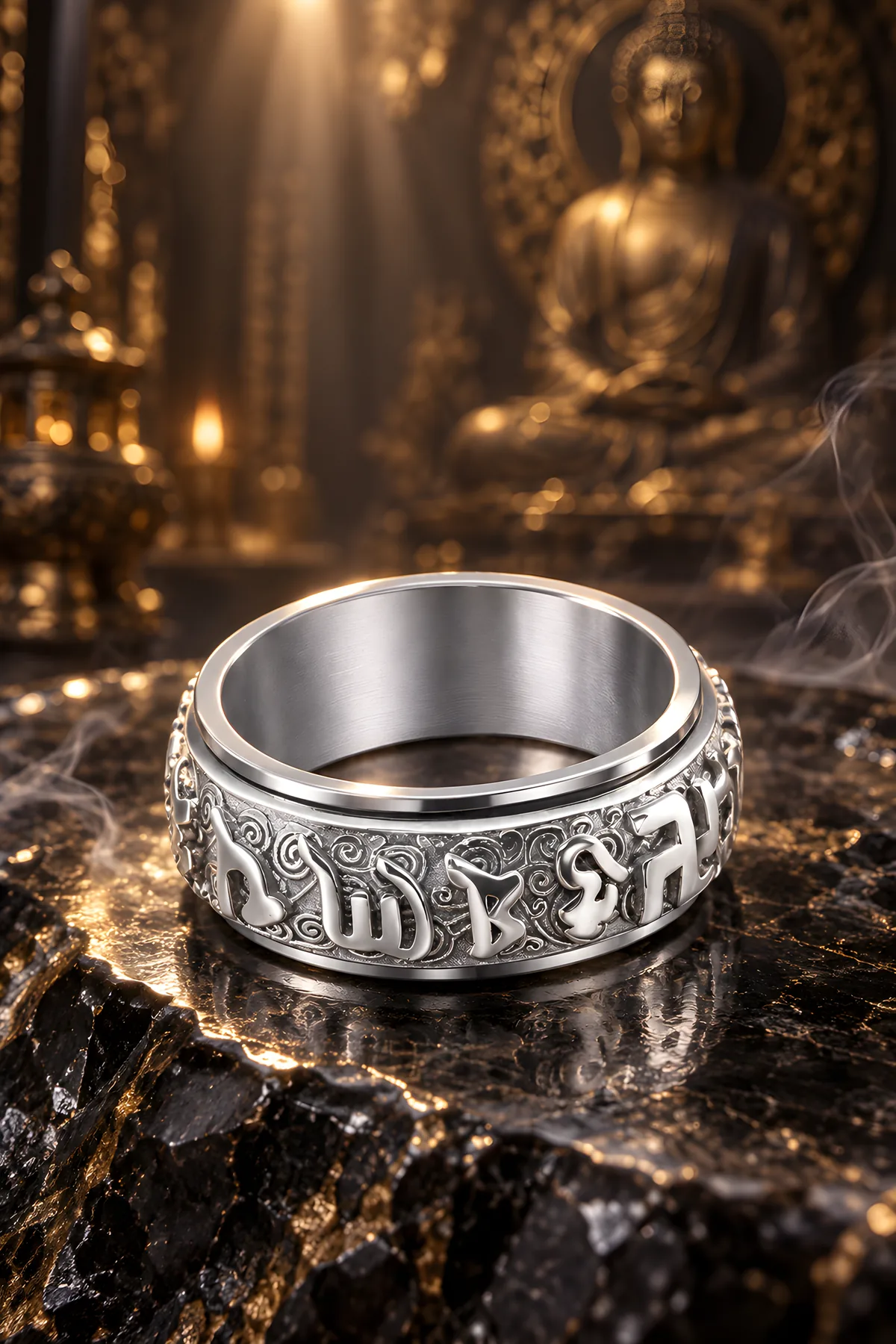
A six-syllable mantra ring is a titanium-steel band engraved with Om Mani Padme Hum, the six-syllable mantra of the Tibetan Buddhist tradition, usually built so the engraved outer ring spins freely around the inner band. You wear it for the engraving rather than for any claimed effect: the product pages are explicit that no consecration, blessing or spiritual outcome is claimed or implied. This guide explains what the mantra means, how the three mantra rings sold here differ — the six-syllable spinning ring, the nine-syllable Bagua ring and the Heart Sutra band — and how to choose between them.
What the six-syllable mantra is
Om Mani Padme Hum is the best-known mantra of Tibetan Buddhism, closely associated with Avalokiteshvara, the bodhisattva of compassion. It is short enough to remember and everywhere in the places where that tradition has travelled: carved onto mani stones, printed on prayer wheels, painted on banners and, in jewellery, engraved around rings and pendants. The syllables are usually rendered loosely as an invocation of the jewel in the lotus, though scholars still debate the exact translation — the mantra’s Wikipedia entry is a good place to start if you want the philology.
On the Six-Syllable Mantra Spinning Ring, the mantra runs as a continuous engraving around a rotating outer band. The product name and title both reference the six-syllable mantra, so the motif is the piece’s own — carried, in the page’s words, as decorative engraving — and the page is just as clear about what the ring is not. Nothing about wearing it claims a result.
The nine-syllable mantra and the Bagua: a Daoist variation
The Daoist counterpart is the nine-syllable mantra, the sequence of nine characters that ranks among the Daoist tradition’s best-known short recitations. On the Nine-Syllable Mantra Bagua Spinning Ring it is engraved alongside the Bagua, the eight trigrams of the I Ching arranged in their circular order, with the Taiji yin-yang figure at the centre of the arrangement. Script and symbol share one continuous field of engraving, so the ring reads as a map of the tradition rather than a single word.
The build is two concentric parts: an engraved outer band and an inner sleeve that rotates freely against it. At 8 mm wide and 9 g in titanium steel it is the middle weight of the three, and its polished-and-brushed finish leaves the raised engraving mirror-bright while the recessed field stays matte. The house describes the piece as decorative Chinese Guochao jewellery — cultural symbolism worn as an everyday signet — and the motifs are, again, presented as engraving rather than as any kind of promise.

The Heart Sutra ring: the seal-script band
The third ring carries text rather than mantra: the Heart Sutra, one of the most widely known texts in the Chinese Buddhist tradition. On the Heart Sutra Wide Band Ring it is rendered in seal script, the ancient squared character form whose strokes turn each line into an abstract, almost architectural graphic. The lettering runs around the band as a continuous field of characters, so the ring reads as engraved text at any angle instead of a single central motif.
This is the wide band of the family: 11 mm across the face and 11 g in titanium steel, a deliberately broad face that carries the seal-script text without crowding. The finish matches the nine-syllable ring — raised strokes mirror-polished, recessed field matte, artisan-sealed to resist tarnish — and it is offered in silver and gold.

What “spinning” adds — and how these rings are made
How does the spin work?
The rotating band is the defining mechanical detail of two of the three rings. Hold the inner ring of the six-syllable piece and the engraved outer section turns; the product page calls it a mechanical detail of the build, made to be handled. On the nine-syllable ring the idea is the same — the outer ring turns independently of the inner sleeve — and there is no separate bearing or loose part to lose, because the band is held in place by the ring’s own construction. The motion is quiet and repeating, which makes both rings natural pieces to fidget with. The Heart Sutra band is fixed and solid by contrast: nothing spins, and the 11 mm face does the talking.
What material are these rings made of?
All three rings are titanium steel, the dense, hard-wearing metal the house uses across its pendant and bracelet lines and explains in its own material guide. Titanium steel takes a high-polish finish and holds a dark-to-bright contrast in the engraving, and the finish is colour-retaining under normal wear — with the honest caveat printed on every product page that no finish is permanent and no absolute guarantee is made. Across the family, weights run 7 g for the six-syllable ring, 9 g for the nine-syllable Bagua ring and 11 g for the Heart Sutra band, with face widths of 8 mm, 8 mm and 11 mm.
Which mantra ring to choose
All three rings are priced the same at $39, so the decision comes down to motif, width and weight rather than budget.
These are house recommendations, not doctrine.
| Ring | Motif | Spin | Width and weight | Finish options |
|---|---|---|---|---|
| Six-Syllable Mantra Spinning Ring | Om Mani Padme Hum, engraved around the rotating outer band | Yes — the engraved outer band turns around the inner ring | 8 mm wide, 7 g — the lightest of the three | Silver, gold or two-tone |
| Nine-Syllable Mantra Bagua Spinning Ring | The nine-character Daoist mantra with the Bagua trigrams and the Taiji figure | Yes — the outer ring turns independently of the inner sleeve | 8 mm wide, 9 g | Silver, gold or two-tone |
| Heart Sutra Wide Band Ring | The Heart Sutra in seal script around the full band | No — the band is fixed; nothing spins | 11 mm wide, 11 g — the widest of the three | Silver or gold |
Nothing here claims the stones change an outcome; they mark an intention.
What is the six-syllable spinning ring?
Pick this for the classic: the best-known mantra on a band that spins. It is the lightest of the three at 7 g, cut 8 mm wide with a high-polish, classic-vintage look, and it reads as a clean unisex signet. Choose silver, gold or two-tone.
What is the nine-syllable Bagua ring?
Pick this if Daoist symbolism is your register. At 8 mm and 9 g it is the heavier of the two 8 mm options, with the Bagua trigrams and the Taiji figure around the nine-character engraving. Choose silver, gold or two-tone.
What is the Heart Sutra band?
Pick this for the widest face and the longest text. At 11 mm and 11 g it wears like a statement piece, best on the index finger or thumb, and the seal-script field gives it a surface worth looking at closely. Choose silver or gold.
If you wear pendants more often than rings, the same six-syllable motif also appears as one of the ten designs on the Engraved Steel Guardian Pendant Necklace — the same mantra in a different form.
Sizing and care
Each product page carries its own size and fit section, and the general rules are simple. Measure the finger with a strip of paper at the end of the day, when hands are at their largest, and remember that a wide band sits across the finger, so the 11 mm Heart Sutra face will feel fuller than a slim band of the same marked size. For care, the finishes are artisan-sealed to resist tarnish, and the rest is ordinary metal care: wipe the ring with a soft cloth after wear, keep it dry and away from household chemicals, and store it apart from other pieces so the polished face does not pick up scratches. As the product pages state plainly, no finish is permanent — that caveat is part of the honesty of the listing, not a defect.
Start with the Six-Syllable Mantra Spinning Ring if you want the classic: the best-known mantra, the lightest build of the three and a band that spins under your thumb. If you prefer a broad face, the Heart Sutra Wide Band Ring is the statement option, and if Daoist symbolism is more your register, the Nine-Syllable Mantra Bagua Spinning Ring is the third door into the same family. Whichever you pick, you are buying the engraving and the build — a piece of cultural script worn as an everyday band, with no claims attached beyond what the metal itself delivers.