Red String Bracelet Meaning: Why Wear a Red Cord?
A red string bracelet is a red cord worn on the wrist as a traditional Chinese symbol of protection, good wishes and connection, worn most often in the wearer’s own zodiac year. That year is called ben ming nian, and red is its customary colour — a red cord bracelet is the lightest, most everyday way to carry the tradition.
This guide covers where the red string custom comes from, what red means in the zodiac year, how the three red cord pieces in this house differ, and how to wear and care for one. Nothing here claims the cord changes an outcome: it is worn as symbolism, the way the tradition has always framed it.
Where the Red String Tradition Comes From
Red has long been the colour of celebration in Chinese tradition: it appears at weddings, at the Lunar New Year and on gifts — envelopes, clothing, decorations — as a colour of joy and warding. From that broad custom comes the narrower one: in the year that “belongs” to a person’s zodiac animal, the tradition calls for wearing red on the body, and a red cord on the wrist is the quietest form that takes.
There is also an older thread, quite literally. Chinese folklore speaks of a red thread of fate tying people destined to meet or to marry — an invisible cord managed by a matchmaker figure in the old stories. It is a tale about connection, not luck: the red cord marks a bond rather than a transaction.
The knotwork belongs to its own craft tradition: the button knots, sliding closures and woven braids used on these bracelets come from the family of decorative Chinese knots documented in the craft’s long written history.
What Red Means in the Zodiac Year (Ben Ming Nian)
Every twelve years the zodiac animal from your birth year comes around again, and that returning year is your ben ming nian. The tradition treats it as a year worth marking with extra care: some families associate it with caution and with red clothing or accessories. But as the house’s own guide to the subject puts it, the custom does not mean the year is unlucky — it is a personal and family symbol, a reminder of heritage and a way to mark a turning point, not a sentence to be feared.
Two practical notes follow from the tradition. First, the zodiac pairing follows the lunar calendar, not 1 January, so a birthday in late January or early February may fall either side of the boundary — check the birth year against the Lunar New Year before choosing a piece. Second, the same tradition pairs each zodiac animal with a guardian figure, which is why so many red cord pieces carry a small guardian charm: the cord and the guardian belong to the same custom.
Three Red Cord Pieces the House Makes
This house carries three red cord bracelets, and each takes the red string idea in a different direction. All three are hand-finished and adjustable, and all three are matched to a birth year rather than picked from a shelf.
What is the Twelve-Zodiac Guardian Red Cord Bracelet?
The 12 Zodiac Birth-Year Guardian Red Cord Bracelet (ET-RCB, $39) is the classic piece: a hand-braided red cord carrying the guardian-Buddha figure matched to a single zodiac animal, offered as twelve separate variants so each piece answers to one birth year exactly. It is cut as a unisex couples piece with an adjustable sliding closure, and it is light enough for a small wrist — the house describes it as the classic Ben Ming Nian piece, and that is the role it plays best.
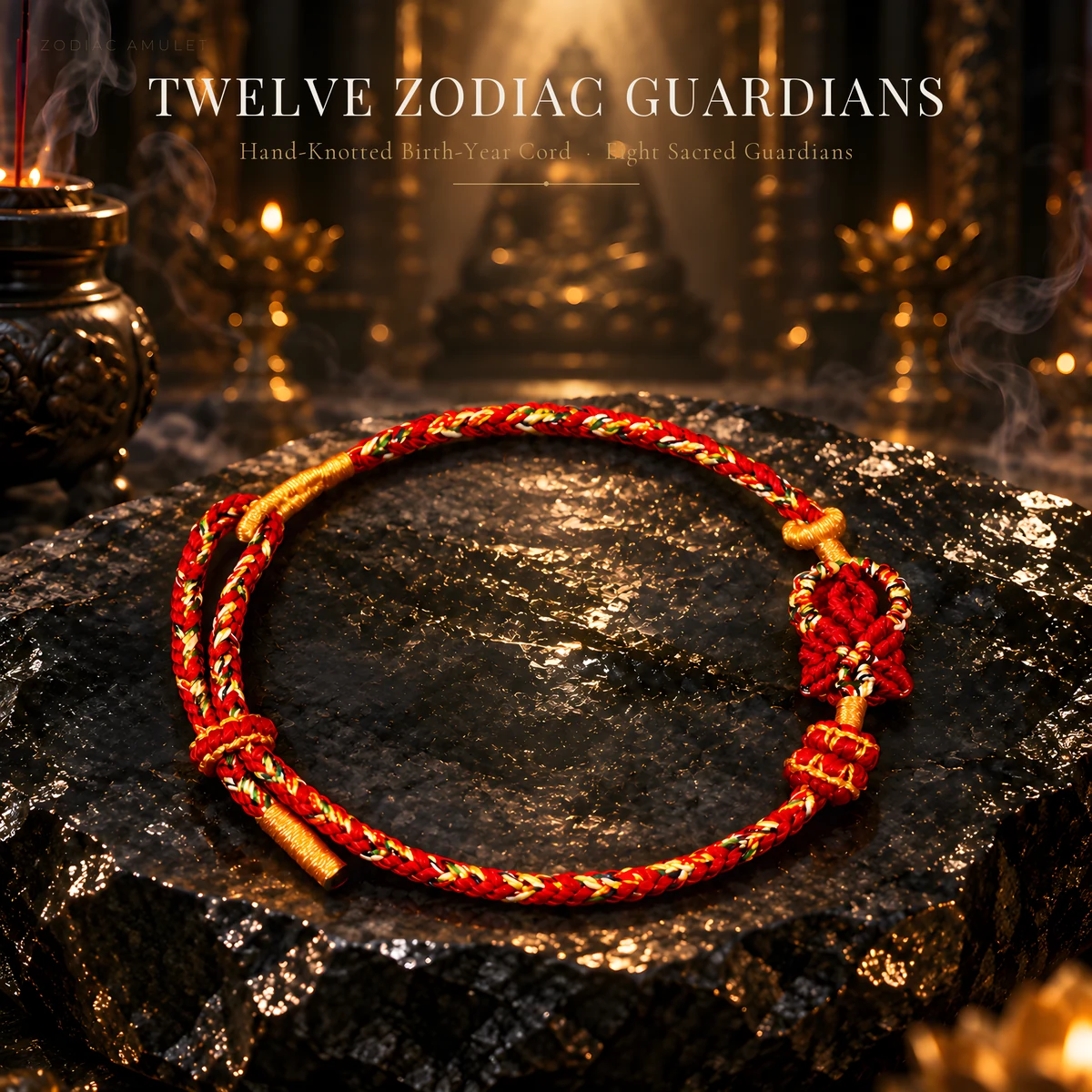
What is the Putuoshan Five-Colour Guardian Cord Bracelet?
The Putuoshan Eight Guardian Deities Cord Bracelet (ET-PTS, $39) swaps the single guardian for a wider system: the twelve zodiac animals are grouped under eight guardian deities, and the bracelet carries a micro-carved cylinder in gold-tone metalwork engraved with a guardian figure and a Heart Sutra passage. Held to a light source, the engraving projects a magnified silhouette through a small aperture in the charm’s face — the same optical principle as a pinhole. The cord is hand-braided in layered five-colour strands with a woven bead-and-loop adjuster, and the 25 cm cord fits a range of wrists.

What is the Twelve Zodiac Guardian Buddha Bracelet?
The Twelve Zodiac Guardian Buddha Bracelet (ET-ZGB, $49) is the knot-heavy take: each cord is hand-knotted in the Tibetan vajra knot, two tones of crimson worked against a band of five-colour cord in the red-yellow-green-black-white sequence used in protective knotting. At the centre sits a silver-tone hexagonal charm engraved with the Sanskrit seed syllable of the wearer’s natal guardian, flanked by gold-tone knotting, with a Chinese button-knot sliding adjuster.
Which to choose comes down to taste rather than rank. If you want the simplest, most traditional red cord, the twelve-zodiac red cord bracelet is the one. If you like an object with a hidden detail, the Putuoshan cylinder rewards a closer look. If you want the knotwork itself to be the star, the vajra-knot bracelet is the most substantial cord of the three.
Who gives it, and when?
A red cord bracelet matched to a birth year is, in the house’s words, a gift that has to be looked up: you need the year the wearer was born to pick the right guardian, and that act of choosing is exactly what makes the gift land. That makes it a natural fit for a birthday, a Chinese New Year, a graduation, a new job or an anniversary — and for couples, who can wear matching cords for their own two birth years.
It also runs the other way: a first zodiac year, a first red cord, small and light on a young wrist. The gift marks the year that belongs to the wearer — a marker of the person, not a wager on the year.
How do you wear and care for a red cord bracelet?
The house keeps a full guide to how to wear a zodiac amulet, and the short version applies directly to cord bracelets: either wrist is fine, and many people choose the wrist they use less so the braid stays snug. Take the piece off for the shower, the pool and the sea — soap, chlorine, salt and heat do the damage. Keep it clear of perfume and household cleaners, and wipe the metalwork with a soft dry cloth after wear.
The braided cord is the part that ages first: it softens with wear and lightens where it rubs, which is normal for the material and part of how these pieces look over time. Store it flat rather than hanging so the braid keeps its shape, and if a cord ever breaks, contact the shop — cords are the most replaceable part of these bracelets by design.
These are house recommendations, not doctrine.
| Situation | What the house guide says |
|---|---|
| Birthday, Chinese New Year, graduation, new job, anniversary | A natural fit for a red cord gift — you look up the wearer’s birth year to pick the right guardian, and the choosing is what makes the gift land |
| Shower, pool, sea | Take the piece off — soap, chlorine, salt and heat do the damage |
| Perfume and household cleaners | Keep the cord clear of them, and wipe the metalwork with a soft dry cloth after wear |
| Storage | Store it flat rather than hanging so the braid keeps its shape |
| If the cord ever breaks | Contact the shop — cords are the most replaceable part of these bracelets by design |
Nothing here claims the stones change an outcome; they mark an intention.
Picking the Right Size and Closure
All three bracelets close by adjustment rather than clasp: the red cord bracelet uses a sliding closure, the Putuoshan piece a bead-and-loop adjuster, and the vajra-knot bracelet a button-knot slider. That means one size covers a range of wrists and there is no sizing to guess before you order. If you are between sizes, or buying for someone whose wrist you have not measured, message the shop before ordering and they will measure the piece on hand.
The next step is to open one of the three product pages above and choose by birth year: the red cord bracelet for the classic Ben Ming Nian piece, the Putuoshan five-colour cord for the projection charm, or the vajra-knot guardian bracelet for the heaviest knotwork. Each page lists its variants, so you can match a piece to a birth year and hand it over ready to wear.