Zodiac Compatibility for Two: Reading the Pairing Grid
The Chinese zodiac compatibility grid gives you three lists: six pairs the almanac treats as the closest possible match, four groups of three it treats as one family, and six pairs it sets in opposition. That is the whole apparatus, and it is shorter than most articles on the subject make it look. What the grid is usually asked to do — predict whether a marriage will hold — it cannot do. What it can do is decide which two pieces you buy: two variants of one design, one animal each, so that the pair reads as a pair without either person wearing the other person’s sign.
The short answer: find both birth years, look up both animals, check the three lists below, then use the table at the end, which turns the result into a choice of piece.
The detail that decides which animal you are
Everything on this page depends on one lookup, and it is not the calendar year. The animal changes at the lunar new year, which falls between late January and late February. Someone born on 20 January 1990 is a Snake, not a Horse, because the Horse year had not started yet.
Note: Natal guardians follow the Chinese Solar-Lunar Calendar (transitioning at Lichun / early February), not January 1st.
If either birth year is uncertain, run it through our birth-year chart for 1930–2031 first. Pairing is the second question; the animal is the first.
The six pairs the almanac calls closest
These are the six harmonies — the pairing the almanac treats as the tightest bond between two branches. Each animal appears exactly once.
| Pair | How the pairing is usually described | What the two of you would order |
|---|---|---|
| Rat and Ox | The one who plans and the one who keeps the routine | Two red cord bracelets, $39 each |
| Tiger and Pig | The one who moves first and the one who absorbs the shock | Two red cord bracelets, or two necklaces in two tones |
| Rabbit and Dog | The one who keeps the peace and the one who guards the door | Two octagon pendants on 60 cm chains |
| Dragon and Rooster | The one who takes the room and the one who runs the detail | Two steel pendants, 41–50 cm chains |
| Snake and Monkey | Two fast minds, one of them quieter about it | Two octagon pendants, or two sand-gold medallions |
| Horse and Goat | The one who goes and the one who makes going comfortable | Two red cord bracelets |
Read the middle column as a description of the pair in the tradition’s own language, not a forecast. No almanac promises an outcome from a birth year, and neither does this page.
The word the tradition uses for these six is the one that means to close or to join — two things brought together until they sit as one. That is why the six are the only pairings usually given as a set rather than a list of preferences: the bond is described as structural, the way a joint is structural, not as a matter of taste.
What the pair buys is simpler than the compatibility question: the two pieces should look like one set and carry two different animals. That means the same design in two variants — which is why the twelve-variant series matter more here than the eight-guardian ones.
The four groups of three
The grid also sorts the twelve animals into four groups of three. These are the trines, and they are what people usually mean when they say a family “belongs together”.
- Monkey, Rat and Dragon
- Tiger, Horse and Dog
- Snake, Rooster and Ox
- Pig, Rabbit and Goat
Three people, three animals, one series. This is the configuration that shows up most often in real orders: three siblings, two parents and a grown child, a small wedding party, a group of friends who have been close since school. The pieces do not need to match exactly — three pendants on a 60 cm chain read as a set even when the animals differ, because the shape and the chain carry the visual weight.
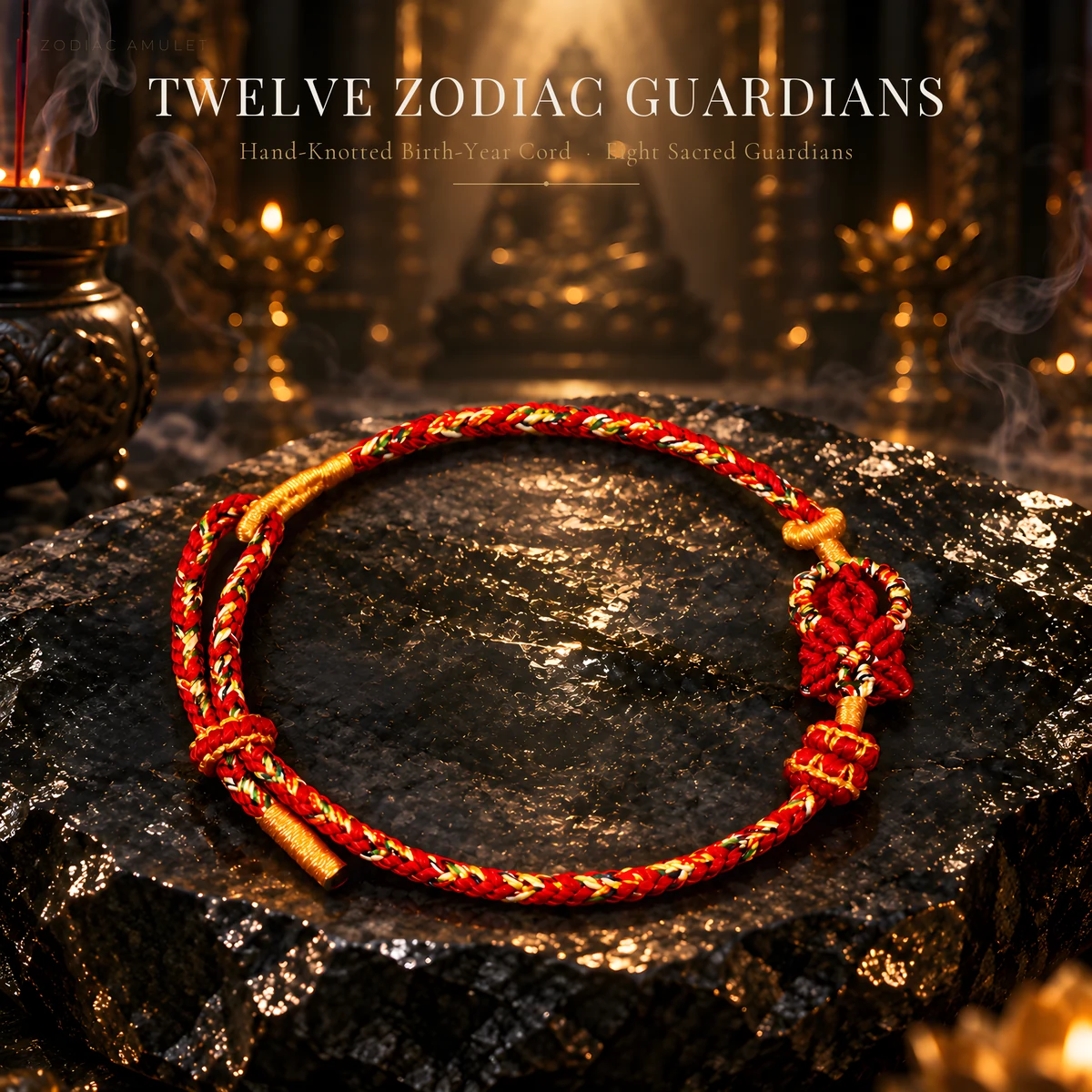
Where they are worn matters more than the diagram suggests. Three bracelets on three wrists sit in a row whenever the three are together; three pendants do not, because the first collar covers them, and a set that disappears under clothing stops being a set. If the trio is a family or a group of friends who want the thing to read as one object in a photograph, the bracelet is the honest choice, and a cord is the version that adjusts to three different wrists without a measurement.
The tradition’s reason for grouping them is structural rather than sentimental: the three branches sit at fixed intervals, and the almanac treats the trio as a single unit the way a chord is a single sound. You do not have to accept the premise to use the grouping. It gives three people a reason to choose three different pieces from one design, which is the whole practical value.
The six pairs in opposition
The opposing pairs are the ones people ask about, and they are the easiest to state. The almanac calls this relation a clash — two branches six positions apart. There are six of them, and each animal appears exactly once: Rat and Horse, Ox and Goat, Tiger and Monkey, Rabbit and Rooster, Dragon and Dog, Snake and Pig.
Two things are true at once here. The clash list is the most quoted part of the grid, and it is the part with the least to say about jewellery. The tradition’s own answer is not “do not marry”; it is that each person keeps their own guardian, and that the pair is worn as two pieces rather than one shared piece. A Rabbit and a Rooster who want matching pendants can have them — one animal each, same design — because neither piece is claiming to be the other person’s.
The grid also lists a softer category, the harming pairs. They change nothing about which piece you buy, and repeating them mostly gives two people something to worry about on a day that should be simple.
When two animals share one guardian
This part is usually left out of compatibility write-ups, and it matters more here than the grid does. Four of the eight guardian groupings cover two animals each:
- Ox and Tiger share Akasagarbha
- Dragon and Snake share Samantabhadra
- Goat and Monkey share Vairochana
- Dog and Pig share Amitabha
Rat, Rabbit, Horse and Rooster each have a guardian of their own.
So if your two animals fall in one of the four shared groups, you have an option that no other pair has: you can both wear the same guardian, in the same variant, twice. On the eight-variant series — the $89 titanium-steel pendant, the obsidian and tiger’s eye bracelets at $59 — that means ordering quantity two of one variant instead of two different variants. For couples who would rather share one figure than wear two, this is the only route the catalogue offers.
If your animals do not share a guardian, ignore this section and use the twelve-variant series, where the animal itself is the variant.

The occasions a pair is actually bought for
Most pair orders have nothing to do with compatibility. They have a date attached, and the date decides everything else. Six situations cover almost all of them.
A wedding. The couple’s two animals, and often a second pair for the two mothers in their own animals. It works best as one design across four variants, with the older pair in the lighter form — the 60 cm rope chain of the octagon piece reads dressier than a braided cord, and a cord reads easier on a wrist at a long dinner.
An anniversary. Usually a round number, or the year a couple stopped buying each other surprises. This is the order where people ask for two necklaces rather than two bracelets, because the pieces are worn to dinner rather than to work.
A new baby. Parent and child, in the child’s animal. The child does not wear it yet — the parent does, which is why this is the one pair where both pieces are usually the same variant ordered twice.
A child leaving home, or going abroad to study. The parent keeps one animal, the child takes the other. This pair gets worn in two time zones, and it is the order most often placed in a hurry, in the week before a flight.
Two friends. Twenty years, or a shared decade, or a group of three who are all in one of the trines. Nobody in this order wants a couple’s set, so the two tones of the steel pendant do the work: same animal in gold and silver, or two animals in one tone.
A business partnership. Rarer than the rest, and usually two pendants rather than two bracelets, because a pendant sits under a shirt collar and a cord does not.
All six share one thing worth planning around: the piece is chosen by birth year, so it cannot be bought on the morning of. You need both years, and you need to check them against the lunar new year before you order.
Which pair to order
These are house recommendations, not doctrine.
| If you are buying for | Start with | Why this one |
|---|---|---|
| A couple, both wrists, everyday wear | 12 Zodiac Birth-Year Guardian Red Cord Bracelet, $39 each | The listing describes a unisex couples cut, and the closure slides, so two different wrists are covered without measuring |
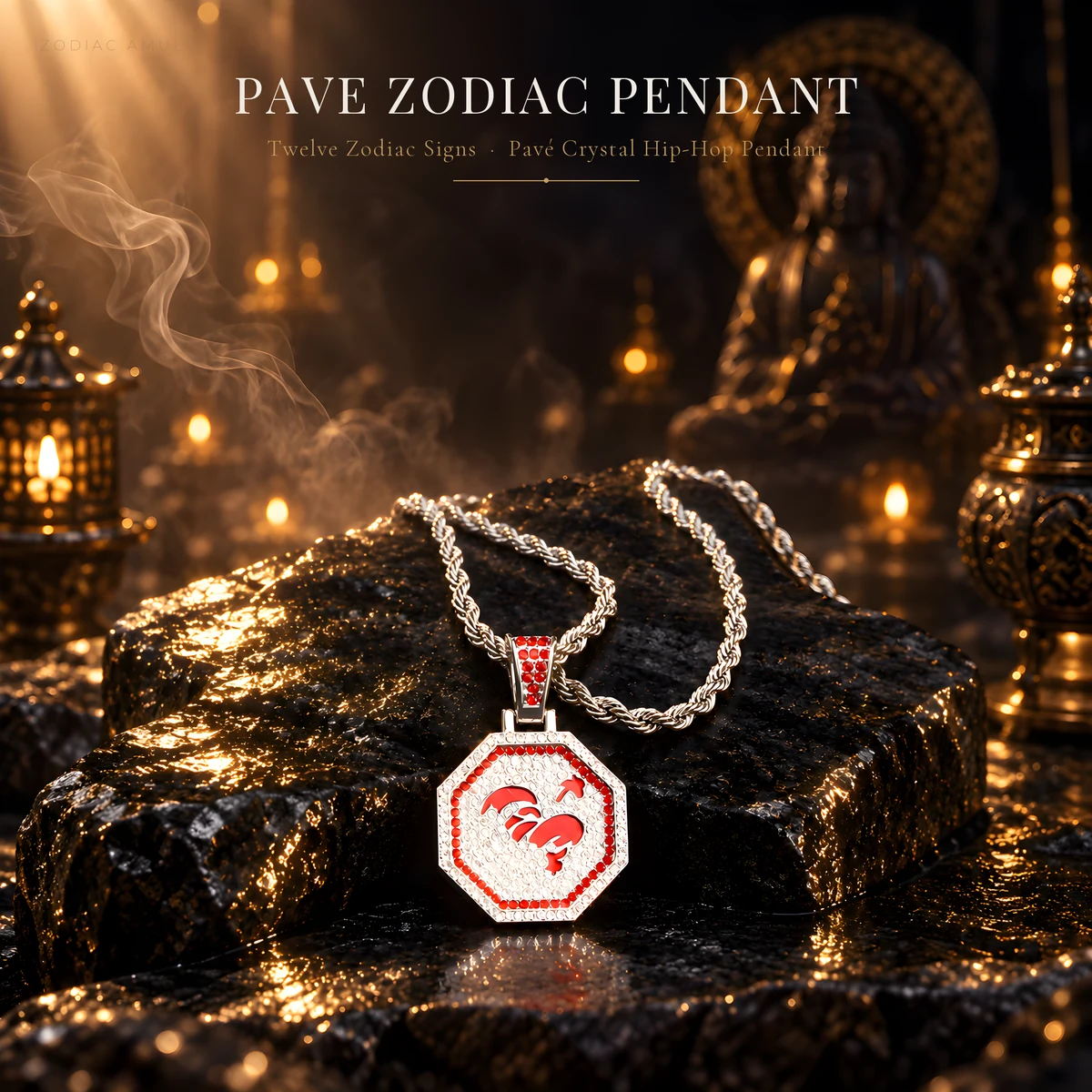
| A couple who want necklaces that sit at different heights | Pave Octagon Zodiac Pendant, $49, plus Steel Zodiac Pendant, $59 | 60 cm against 41–50 cm: two lengths layer without tangling, and both series run all twelve animals |
| Two friends or siblings who want to be told apart | Steel Zodiac Pendant, $59 | Twelve animals in a gold tone and the same twelve in a silver tone: same animal in two tones, or two animals in one tone |
| A parent and a grown child | Red cord, $39, plus Pave Octagon, $49 | The cord adjusts to any wrist; the pendant reads as an adult piece rather than a child’s keepsake |
| A pair where one of you is a Snake | Red cord, octagon, or steel pendant | The sand-gold medallion is offered in eleven animals and has no Snake variant — check before you build the pair around it |
| Two animals that share one guardian | Any eight-variant piece, quantity two | Ox and Tiger, Dragon and Snake, Goat and Monkey, Dog and Pig can wear the same figure |
Nothing here claims the stones change an outcome; they mark an intention.
Sizing two pieces at once
Two pieces means two sets of measurements, and this is where most pair orders go wrong. The red cord bracelet is one size with an adjustable sliding closure, so it covers a range of wrists and asks nothing of you. The two pendant series publish their chain lengths — 60 cm for the octagon, 41–50 cm for the steel cross chain — and those are different fits, not two versions of the same fit. If you want the two to sit at the same point on the collarbone, buy two of the same series. If you want them to layer, buy one of each deliberately.
The sand-gold medallion publishes its dimensions, 22 mm by 15.7 mm, and no chain length, so treat it as a piece you wear at whatever the supplied chain gives you.
For care, the rule is the same for both people: wipe the metal with a soft dry cloth after wear, keep it away from perfume and chlorine, do not wear either piece in the shower or the pool, and store flat rather than hanging so a braided cord keeps its shape. Two pieces age at the same rate only if they are looked after the same way, and in most pairs one person is tidier than the other.
What a pairing can and cannot do
A birth year is a cultural marker, not a measurement of a person. The six pairs, the four trios and the six oppositions are almanac material — they come out of the branch system that also produces the calendar, and every almanac prints them slightly differently. They are not Buddhist doctrine, they are not a prediction, and nothing in the grid has ever been shown to affect how two people treat each other. What the tradition does offer is a vocabulary: a way of saying “we are a set” that does not require either person to explain themselves. That is worth something at a wedding, and it is worth very little as a forecast. The pieces are decorative cultural jewellery, worn as symbolism. The rest is a conversation you two are having, and the grid is only the opening line.
Common questions
Five questions that come up most often when two people order together.
My partner and I have clashing animals. Should we skip the matching pair?
No. The clash list describes two branches in opposition; it does not forbid a pair of gifts. The tradition’s own resolution is that each person keeps their own guardian rather than sharing one, so order two variants of one design, one animal each.
Can two people wear the same animal?
Yes — two Tigers, a mother and daughter born in the same cycle, or a couple who simply prefer one animal. Order the same variant twice. On the steel pendant you can also split the gold and silver tones so the two pieces are not identical.
Which animals share a guardian, so we can both wear the same figure?
Ox and Tiger share Akasagarbha, Dragon and Snake share Samantabhadra, Goat and Monkey share Vairochana, Dog and Pig share Amitabha. Rat, Rabbit, Horse and Rooster each have their own. In one of those four groups, an eight-variant piece ordered twice gives you one figure between you.
Do we need to order both pieces at the same time?
No, though it is simpler to. Both ship from the same workshop, and a pair ordered together arrives together, which matters when the pair is a gift with a date. If you order separately, check the variant is still in the same series.
What if one of us was born in January or early February?
Then the lunar new year decides the animal, not the calendar year, and January birthdays are where most wrong animals come from. Check both years against our birth-year chart before ordering, because the variant you choose is the whole point of the piece.
Sources
Chinese zodiac compatibility grid — San He, Liu He, Liu Chong and Liu Hai pairings, Wikipedia, consulted 7 November 2026: https://en.wikipedia.org/wiki/Chinese_zodiac
Chinese astrology — the Earthly Branch system behind the pairings, Wikipedia, consulted 7 November 2026: https://en.wikipedia.org/wiki/Chinese_astrology
Guardian-to-animal pairing used on this site, with the Lichun boundary: our eight guardian deities chart
Shop this guide
12 Zodiac Birth-Year Guardian Red Cord Bracelet — $39, twelve animals, adjustable sliding closure
Pave Octagon Zodiac Pendant Necklace — $49, twelve animals, 60 cm rope chain
Steel Zodiac Pendant Necklace — $59, twelve animals in gold and silver tones, 41–50 cm chain
Sand-Gold Zodiac Buddha Pendant Necklace — $59, eleven animals, animal on one face and guardian on the other
Further reading
The Zodiac Gift Guide: who gets which piece, by relationship
Which of the eight guardian deities is yours
How to wear your zodiac amulet: which hand, water, sleep